The Good Energy Conference will introduce the Forum for Energy Communities in Croatia

April 19, 2024 – The Green Energy Cooperative (ZEZ) in partnership with the European Commission Representation in Croatia is organizing the Good Energy conference on April 25, 2024 in the premises of Wespa Spaces (Radnička 50) in Zagreb. The focus of the fourth edition of this ZEZ’s regular event dedicated to community energy are energy communities and the perspective of their development in Croatia.

Behind the concept of energy community is an opportunity for all citizens of the European Union, including Croatia to independently produce, share and sell renewable energy. For example, a group of owners of family houses, small businesses and public institutions in a neighborhood can install a joint solar PV plant and independently produce the energy they need through an energy community . The key advantage of such citizen participation in the energy market is that the economic, but also social benefits of renewable energy as a local resource remain in the local community. Experience in other European countries shows that such a form of investment in renewable energy brings two to eight times more benefits to the local community than renewable energy projects from external investors. 

Energy communities were introduced into the Croatian legal framework in 2021, and by spring 2024 only one had been formally established. The conference will therefore open a space for dialogue between decision-makers and practitioners, thus contributing to visibility and solutions to obstacles to more energy communities in our country, but also further focus on the role that energy communities can play in combating energy poverty.

Program of the Good Energy will be opened by Gabriele Giudice, Deputy Director General of the European Commission’s Directorate-General for Economic and Financial Affairs (DG ECFIN), who also supervises the implementation of the Croatian National Recovery and Resilience Plan. He will share expectations towards the EU member states for the development of energy communities. In addition to local experts who will present the Forum for Energy Communities in Croatia, some of the most successful energy cooperatives from other European countries will share their experiences. Among them is the French cooperative Énergie Partagée and the Dutch cooperative Energie Samen which are known for the financial mechanisms they provide for the multiplication and development of new energy cooperatives. They will be accompanied by the cooperative Enercoop which contributes to combating energy poverty in France through microdonations of its members when paying energy bills.  

The Good Energy conference is intended for community energy initiatives, experts and practitioners in the field of renewable energy, representatives of institutions, local governance units and all those interested in faster development of energy communities in Croatia. 

Take a look at the program and sign up for participation via the conference website: https://dobraenergija.zez.coop/en/ 

The Good Energy Conference is organized as part of the projects ACCE – Access to Capital for Community Energy and COMET – Coalitions for Community Energy Catalyzation in Eastern EU which are financed from the LIFE program of the European Union, and the projects CEES – Community Energy for Energy Solidarity and SCCALE 20-30-50 which are financed from the Horizon 2020 program of the European Union by grant agreements no. 101026972 and no. 101033676.

ZEZ Sun: In ten days citizens have secured 140.000 euros for a shared solar power plant

March 13, 2024 – The cooperative ZEZ Sun raised 140,000 euros in member shares in just ten days after the opening of its first call for members, thus securing the entire investment for a solar power plant owned by citizens at the City of Križevci’s City Market. As members of the ZEZ Sun, individuals and legal entities will become co-owners of its solar power plants and generate yields. ZEZ Sun is inspired by community energy initiatives operating across Europe, which are also encouraged by the European Union in the form of energy communities. In practice, ZEZ Sun represents the first example of an energy community in Croatia.

The first call for members of ZEZ Sun opened on March 1 with the support of the Green Energy Cooperative, the City of Križevci and the energy cooperative KLIK. Until March 11, 108 citizens responded, of which 93 new and 15 existing members of the cooperative. In the first seven days since the opening of the call, the citizens of Križevci and surrounding municipalities had the advantage of membership and investment, and have provided a quarter of the necessary funds, i.e. 33,000 euros, while in just three days since the opening of the call for the rest of the country citizens from other cities provided the remaining 107,000 euros.

“We are delighted with the speed of response to our first call for members, that citizens recognize the value of this story and that they have given us a chance. We also call on cities across Croatia to cede city roofs to citizens and thus ensure that the value of solar energy, which is usable in every part of our country, is retained locally”, said Mislav Kirac, manager of the ZEZ Sun.

“Thank you to everyone who responded to the first call for membership in the energy cooperative ZEZ Sun and thus enabled the raising of funds for the construction of a solar power plant at the City Market. Citizens’ support of this project confirms that they have recognized the importance of the energy transition and decided to take the energy into their own hands. This is the inclusion that we promote in Križevci, that citizens voluntarily and without any pressure create their future. I am glad that Križevci was the first city in which a ZEZ Sun project was implemented, which confirms that we are the leader of the energy transition in Croatia. I would like our example to be followed by other municipalities and cities in Croatia because Croatia is full of potential for such projects, it just needs to be brave and catch the opportunity provided by renewable energy sources. Križevci recognized this opportunity, and with the support of its inhabitants, energy independence is becoming  reality”, said Mario Rajn, mayor of Križevci.

The installation and commissioning of a 200 kW solar power plant at the City Market in Križevci is planned for autumn 2024. ZEZ Sun will sell energy on the market, of which part of the realized profits will be distributed to members, while a part will be invested in community projects. The long-term goal is that members can use the energy produced by the cooperative’s solar power plants in their households or business facilities. ZEZ Sun will open calls for members periodically, after contracting new projects.

SOL4All or The Sun is for All of Us!

Source of cover foto photo: Unsplash/Tod-Rhines

This year at the Green Energy Cooperative we are marking the tenth anniversary of our activities in the field of community energy. In practice, it means that behind us is a decade of work on empowering citizens and local communities to become active participants in the energy market. Our focus is on supporting citizens to produce their energy from the Sun by investing in integrated solar photovoltaic power plants for their homes, or large solar photovoltaic power plants on public buildings by forming energy communities.

To be an active participant in the energy market also means acquiring knowledge about managing your production and consumption, sharing surpluses and having concrete benefits such as energy savings and revenues. In this way, active citizens contribute to energy independence, reduced fossil fuel use and to climate change mitigation. This also ensures more economic activity and revenue retention in the local community. Relevant EU directives and regulations encourage all we have been working on, but it doesn’t work straightforwardly and is not as simple as it may seem. 

We don’t know it, we don’t have it, but we could?

In Croatia prevails low awareness on the benefits of solar energy and insufficient understanding of the process of installation and use of solar power, which is directly related to the amount of green energy produced. With only 2 % of electricity generated from the Sun, we are at the bottom of the EU countries’ ranking, while the EU average in 2022 was 8 %. Our “yellow slice on the cake” that shows the structure of available electricity is so thin that it is barely visible, despite the very large solar potential we have as a country in Southeast Europe and the Mediterranean. This low production is in complete opposite of our potential and that’s why we at ZEZ decided to change that.

Image: Structure of available electricity in The Republic of Croatia in 2022. Source: Renewable Energy Sources-Croatia Association (OIE-H): https://oie.hr/elektroenergetska-kretanja-u-hrvatskoj-u-2022/

Shortly after the “world stopped” due to the coronavirus pandemic, we established a non-profit service for citizens “On the Sunny Side” that brings together all we do at the website nasunčanojstrani.hr. Through the service, we make the process of realization of a solar power plant faster, easier and more financially profitable by advising citizens in making investment decisions. We also provide a turnkey service and group procurement of equipment and installation

In the process of designing our service, we were guided by insights from the field and by several different surveys of public attitudes towards renewable energy sources in Croatia done in 2021. At that time, more than 80 % of respondents did not use renewable energy sources in their households (1), citizens were not familiar with the process of obtaining permits for their own production of electricity (2) or with the concept of energy community, but in principle they were open to joint electricity production with neighbours. The prevailing attitude was that the state insufficiently informs citizens about the possibilities of its electricity production and insufficiently promotes the corresponding incentives.

Over the past year, with the support of Google.org, we have further digitised and improved the service “On the Sunny Side” to bring the benefits of solar power plants as close as possible to as many people in Croatia. The key to the energy transition is not only in new or advanced technology but also in people who have the knowledge and motivation to use all its potential.

How do you “switch” as many citizens as possible to the sunny side?

We developed and implemented our activities in two directions. The first direction is a set of “soft” but essential activities of different ways of education and advanced use of digital infrastructure. For example, this is the free Solar Literacy course of seven modules available to everyone on the service’s website, which we developed out of a series of our webinars and live lectures.

More than 80 % of our workshop participants say that it is now much easier for them to explain to their friends the benefits of solar energy and the process of setting up a power plant; and that they are more motivated to use solar energy than before.

We have also digitised our processes by introducing a customer management system, which significantly increases our efficiency. Now we can address the issues described before in a way that is more modern, flexible and faster than the “analogue” way. Our education and assistance package encourage actions and change of behaviour of citizens and ultimately increase the number of installed power plants.

Impressions of citizens – participants of education

-For me, the influence of the workshops was that it helped me decide to use renewable energy sources and to start installing a solar power plant for my household needs.

-Now I’m thinking about putting photovoltaics on my house and opening a company that will sell and install PV.

-I’m going to talk to neighbours about working on a joint smaller solar power plant in our neighbourhood.

The second direction is a set of activities that have increased the visibility of our service and in general the benefits of using solar energy in households.

We have upgraded the content and functions of the website with a lot of useful information for citizens. We improved the solar calculator that provides initial information on the cost-effectiveness of investment. We set up information about fifty partners important in the solar value chain – from designers and installers to suppliers of equipment. And we created the already mentioned Solar Literacy course.

We also got out to the streets of about thirty cities with our Good Energy Tour. In addition to the “Sunny Living Room” intended for citizens, during the Tour we held workshops with representatives of local self-government on their role in the solarization of cities.

Impression of a representative of local government, participant of an educational workshop for cities on the good energy tour

We as employees of cities have to cover very diverse activities and often, especially in smaller cities, cannot follow legal changes or the trends in a very specific field such as energy. By going through the education and the solar literacy modules of ZEZ, we had the opportunity to gain the basic knowledge we need, and more importantly, about the role of local communities in the solarization process. In addition, it is most useful for me to know that we have someone behind us as professional support. I can always contact ZEZ for help as a reliable source of information. For example, their solar calculator is also a great help, which I regularly use in direct contact with citizens who want to install solar panels in Poreč.

Gordana Lalić 
PARENTIUM Ltd.
City of Poreč-Parenzo 

The key to a just and inclusive energy transition is people who are informed, possess knowledge and have the available support to decide and implement change toward their own energy production. Young people are also important not only because the energy transition directly affects their future, but also because some of them are in the phase of choosing further education and occupation paths. There is a wide range of green jobs related to solar energy such as design, installations, smart management and storage systems, hence we have implemented a part of our education in secondary vocational schools in Istria, one of the two Croatian regions selected for the use of the EU Just Transition Fund.

Impressions of students and professors of the Industrial and Crafts School Pula, Gymnasiums and vocational schools Labin and Buje School of Commerce – participants of educational workshops in Pula

The lecture was worth it, I learned a lot. This has helped me a lot and I think I’m going to install my solar panels.

The lecture was interesting, it is the future and it is good for students to know that there is also this possibility for further career development.

The lecture was very instructive and provides a good starting point; it will come in handy and will inspire them for further education and work.

Photo/ZEZ: Istrian high school students – solar literacy education participants

One of the biggest advantages of this project for ZEZ, but also for our users, is certainly the digitalization of the service “On the Sunny Side”.  Now citizens and employees of city administrations have easier access and can visit our improved website at any time. We have created a sustainable infrastructure for education as the largest long-term outcome of a project, directly affecting the knowledge, awareness and motivation of users and contributing to the change of behaviour in energy management.

Our results in numbers

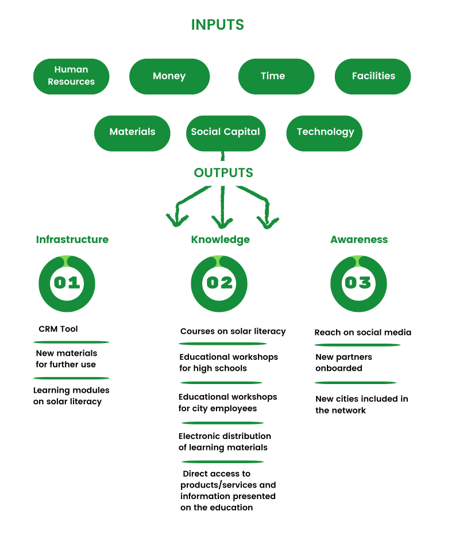
    • Our content and educational activities have reached over 14.000 citizens thus helping them decide on investing in a solar power plant.
    • More than 10.000 people viewed education content on ZEZ’s YouTube channel.
    • The Solar Calculator was used by more than 4000 users; about 100 attendees of Solar Literacy e-learning modules passed the test and got a certificate.
    • We conducted about twenty in-person educations with specific target groups – with Istrian high school students and with city officials on the Good Energy tour.
    • We have ensured the installation of almost 1 MW of new solar power plants on family houses.
    • We have created a network of over 50 partners in the solar power value chain.
    • We have included 20 new cities in our network of Good Energy Cities thus encouraging them to additionally support their citizens in the use of solar energy.
    • We reached nearly one million citizens through our social network channels


Scheme: What we have invested and what we have achieved: our results in numbers.


From “Maybe” to “YES!” for solar energy

The important impact of the project is two-fold: on one hand, it managed to shift many people from “Maybe” to “YES!” towards green energy; and on the other hand, it tested and proved the mechanism of how to do it in a specific context. 

It is also essential to understand the role of the community in a bottom-up, community-driven change context. It was the website and the entire service On the Sunny Side that connected different actors in the community of experts, public administration employees, craftsmen, schools, entrepreneurs, installers and citizens themselves who were given space to communicate and have easy access to knowledge and support. 

With the support of Google.org in this project we have enabled the community to possess and easily access resources, which is the largest and most sustainable created impact that directly reflects on users and contributes to change. Visit us On the Sunny Side because the Sun is free and available for everyone who knows how to use it!

(1) Slijepčević, Sunčana and Kordej-De Villa, Željka (2021). “Public attitudes towards renewable energy sources in Croatia”, in Economic impacts of the development of renewable energy sources, URL: https://www.mdpi.com/1996-1073/14/23/8111 .
(2) https://www.iusinfo.hr/aktualno/dnevne-novosti/matic-gra%C4%91anima-ugradnju-solarnih-panela-otezavaju-zakoni-i-nedostatak-financija-52911

COMET – Our new project will build coalitions for community energy

November 22, 2023 – Green Energy Cooperative (ZEZ) opened the implementation of the international project “COMET – Coalitions for Community Energy Catalyzation in Eastern EU” by gathering partners at a two-day project meeting in Zagreb. ZEZ will coordinate this new project in the field of community energy on behalf of the international project consortium consisting of REScoop.eu – European Federation of Citizen Energy Cooperatives (Belgium), Electra energy (Greece), Technical University of Tallinn (Estonia), Solidarity Economy Center (Hungary), Focus – Society for Sustainable Development (Slovenia), PLZ Spoldzielnia CoopTechHub (Poland) and Cooperativa de Energie (Romania).

The goal of the “COMET” project is to influence the development of supporting conditions for community energy by joining in advocacy and capacity development activities with leading energy cooperatives and communities in the EU, especially the Eastern EU. The project is financed through the LIFE Program, an EU instrument for financing activities in the field of environment, nature and climate protection, in the amount of €1,499,825, while the total value of the project is €1,578,764.

“Naturally, we took over the coordination of this project in line with a series of activities that we are undertaking to enable simple establishment of energy communities and community energy in general in Croatia, but also in line with many years of active cooperation with relevant organizations in the field of community energy in the region and the EU. This project is complementary to other advocacy projects that we are implementing, and we have no doubt that it will play a significant role in the changes in the field of community energy that we aim for in the years to come.” said Erica Svetec, manager of the “COMET” project for ZEZ.

The project will build national coalitions for community energy that will work together to simplify procedures and create better conditions for citizen participation in renewable energy projects, and then conditions for replicating good practices that the coalitions will create. The strength of the project lies in the project consortium that has a good understanding of the complex obstacles that hinder the involvement of citizens in renewable energy projects in the Eastern EU. The consortium is made up of cooperatives, non-governmental organizations and academic partners, thus covering a broad set of expertise needed to successfully implement project activities and ensure its impact.

The “COMET” project will be in implementation until October 31, 2026.

ACCE - Access to Capital for Community Energy

Access to Capital for Community Energy – ACCE

Access to Capital for Community Energy – ACCE is a European project that aims to develop and scale up Community Energy Financing Schemes across Europe.

About 

Community energy projects are facing specific barriers, which need to be addressed through dedicated financing programmes and products.

The Access to Capital for Community Energy (ACCE) project aims to investigate, develop and scale innovative and collective financing tools for energy communities in Europe. Building on existing knowledge and working to meet the need for capital to finance European community energy, this EU-funded project marks a new step in the successful energy cooperative work.

ACCE partners will look into the creation of successful funding concepts at European level: Community Energy Financing Schemes (CEFS). Moreover, thanks to a diverse consortium, they will bring together national and regional funds to support the growth of local projects.

The final goal is to build a “bicycle highway” of community financing – a financing infrastructure dedicated to accelerating the development and scaling of community energy projects.


Key objectives

The key objectives of the ACCE project are:

  • To develop five CEFS in five target countries (Belgium, Germany, Croatia, Romania and Spain) to set up energy communities at national or regional level.
  • To enlarge and expand two existing CEFS (in scope and capital) in the Netherlands and France.
  • To set up a European intermediary to facilitate access to EU capital and funds by national CEFS.
  • To commit 20 million euros to new and existing CEFS.
  • To trigger 90 million euros of citizen investments through the creation of CEFS (referring to the amount of private capital invested in projects triggered by ACCE).


What is a CEFS ?

We consider a Community Energy Financing Scheme (CEFS) to be a financing scheme that funds community-based energy transition projects (sustainable energy, mobility, efficiency…) to overcome financial barriers that the community cannot overcome itself. The primary purpose of those projects is to provide environmental, economic or social community benefits rather than financial profits.

For example, in France, the cooperative Energie Partagée manages a fund dedicated to investing in community energy projects. The fund collects citizens’ savings, in the form of shares, to invest in renewable energy projects (solar panels, wind turbines, biogas and hydropower) together with public bodies and the private sector.

ACCE logo main

The ACCE project has received funding from the LIFE Programme of the European Union.

ACCE logo 1

ACCE logo 2

From Sunči app and nudging interventions to energy efficiency of your household

The strategic priorities of the European Union set by the Green Deal have put focus on the green, energy and digital transition towards a climate-neutral continent.

The strategy overflows into the legal package Fit for 55, and it is reinforced by the program for accelerated transition and reduction of dependence on imported fossil fuels called RePowerEU, with ambitions for more savings and more energy produced from renewable sources, including solar. In order to achieve this, a lot of effort and investment is needed, and not only in technologies like PV systems and digital infrastructure, but also in people, in empowering users to more actively and effectively monitor and manage their energy consumption through new behavioral patterns.

It is consumer behavior that brings us to the topic of the European project NUDGE in which the Green Energy Cooperative (ZEZ) participates as a partner by implementing innovative pilot interventions to encourage changes in energy use. We asked its project manager Lucija Nađ to guide us through the important insights of the project.


What is “nudging”?

Nudging is a term from behavioral economics and psychology that suggests that small changes in the environment can prompt people to make decisions that are in their best interest. Thus, nudging is a subtle reminder or suggestion designed to influence behavior in a specific, predictable way, often making a particular choice easier or more attractive, without limiting freedom of choice. An example from everyday life is placing healthy food products at the eye level in a canteen, which can be considered an incentive to make healthier food choices. The key is to design incentives that are not intrusive, that are easy to understand and attractive to the target audience.

In our example, it is about encouraging users to reduce electricity consumption through smarter and more efficient management of self-consumption in households that also produce their energy with a solar PV system. In the NUDGE project, nudging techniques were used to encourage behavior change in the form of content that users see and learn using the Sunči app, which the Green Energy Cooperative developed specifically for this purpose. For example, the app tells the user “Today is a sunny day, your solar PV system is producing at full capacity, which is an ideal time for self-consumption of electricity: turn on the washing machine or/and charge the battery of your EV.” The ultimate goal is to maximize self-consumption of energy in the simplest possible way.

How does it work?

Based on the results of research conducted in 29 EU member states, including Croatia, insights about their behavior and energy efficiency have been collected. Behavioral experts have used that to create profiles of six types of energy consumers.

Consumer types vary from those who are environmentally and energy conscious and well informed, to those who are concerned but primarily oriented towards comfort; those who are tech-agnostic, love comfort and behave irresponsibly towards energy consumption; and those who are materialistic and run away from personal responsibility, but are “afraid” of high expenses. You can find more about the types of consumers and incentives for behavioral changes through this informational poster.

What is Sunči and what was ZEZ’s focus within this project?

In order for users to be able to manage their energy consumption, they must be able to monitor energy data, such as production from a solar PV system, household consumption, self-consumption, and energy delivered and taken from the grid. This required the installation of smart meter devices to collect this data, and to make the data available to the users in an educational and comprehensible way, we created the Sunči app. The app was tested on 82 users.

Let’s meet Sunči: Sunči collects data via a smart meter device (Shelly) that is installed in the main fuse board in the house to measure electricity consumption in the household and in the fuse board of the solar PV system, where it monitors production and consumption. The collected data is translated into graphics that enable the user to easily manage household consumption in relation to energy production. Sunči is the first application of its kind that shows users’ measurement data, and in Croatian!

Through Sunči, we also sent nudging interventions – advice to users according to their user type. We are now in the third and last intervention before the end of the project. This intervention was preceded by an intervention that gives feedback and raises awareness about consumption, and an intervention that nudges a consumer to set a desired goal for savings. ZEZ plans to continue developing the Sunči app and offer it for use to other interested consumers after the end of the project.

At the beginning of the implementation of the NUDGE project, we launched a communication campaign to identify users who meet the technical conditions to enter the pilot group of the project. Out of over 430 expressions of interest from all over Croatia, 82 users from the area of Slavonia and Continental Croatia were selected to receive free smart meter devices for monitoring energy consumption and production in the household. We had to limit the geographical area of the pilot group due to the similarity of climate characteristics, the intensity of solar radiation, and the availability of local installers – that is, the implementation of the research itself, so there would be no deviations and irregularities in the collected data.

“I like the devices because they are as accurate as the bills I get from the HEP (Croatian electricity company), but the HEP readings only come next month so you can’t track your daily consumption and production, whereas with Sunči you can, which is much better and more practical. It simply makes sense.”

“It is necessary for something like that to exist in Croatia. It is a pity that the installers do not immediately do this when installing the solar PV system to manage its production and consumption. It is also a shame that the law is so strict that you move to another model of consumption if you exceed the production limit. Without monitoring, you can’t know how much you spend and produce.” – user from the city of Vrbovec, Croatia

“I like to see the graph, but you can’t see the numbers unless you click on a column. The Shelly device has a more complicated app compared to the Sunči. Sunči is simple, understandable, has a nicer name and it is great that it is in Croatian!” – user from Prigorje Brdovečko, Croatia

Why is this important?

We have noticed that electricity users often do not understand how energy is consumed. It is not clear to the majority which devices in the household consume more and which less energy, which is important for efficient management of self-consumption in the real time. Users are aware that there is a higher (more expensive) and lower (cheaper) tariff, but they lack a way to monitor actual consumption, especially in relation to the production of their own solar PV system. With the Sunči app, all of this is monitored in one place. Encouraging changes in the use of energy is an important solution that results in the adoption of habits that contribute to reducing the carbon footprint, more efficient use of local resources and increasing energy self-sufficiency. At the same time, the user’s energy and environment awareness increases.

What did the research of other project partners show?

The project includes a total of five pilot locations at the EU level, each focused on a different segment of the use of renewable energy in the household. In Belgium, they were engaged in education system to raise awareness about energy efficiency from a young age, in Greece they encouraged efficient management of heating and domestic hot water by installing smart meter devices, in Portugal they encouraged energy savings (electricity and gas heating) in households of families with children, while in Germany they focused on EVs and charging optimization. The pilot locations have shown that nudging techniques are applicable in different segments of energy consumption. With the help of behavioral science, we can significantly contribute to a more responsible and efficient use of energy.

Next steps?
We invested a lot of effort and time in the development of the first Croatian app that offers the possibility of monitoring energy consumption and production for households that have installed solar PV systems. With the experience gained, we see room for its improvement with new features. We are grateful to our group of 82 pilot users who decided to join this project and test this innovative solution with us. Thanks to the feedback they contribute with, Sunči will soon have some new functionalities.

NUDGE project has received funding from the European Union’s Horizon 2020 research and innovation programme under grant agreement No 957012.

Thank you – Together we provided 111 energy-saving kits!

To help elderly citizens at risk of energy poverty in the City of Zagreb and Zagreb County, the Green Energy Cooperative (ZEZ) and the Solidarna Foundation launched the Ease Their Troubles campaign at the end of October to collect funds for energy saving. The campaign aimed to collect HRK 60,000.00 for the purchase of at least 100 energy-saving kits. During the campaign, from 26th October until the 1st of December 2022, we collected HRK 64,713.47. Raised funds provided energy-saving kits for 111 households!

From all our hearts we want to thank all the individuals, companies, and organizations that helped achieve this goal, either by donating or sharing information about the Ease their Troubles campaign. We believe that your support will give long-term value to all users of energy-saving kits. ?

During the campaign, a total of 189 donations were made, of which 178 were by individuals and 11 by legal entities. The lowest individual donation was HRK 5.00, while the highest was HRK 10,395.00. The average donation amount was HRK 342.39.

All donors, individuals, and organizations, have passed the assessment process according to the Rulebook on Relations with Donors and the Rulebook on Conflict-of-Interest Management.

Next steps

Green Energy Cooperative (ZEZ) and the Solidarna Foundation will start the process of collective procurement of energy-saving kits in December 2022. Green Energy Cooperative will also evaluate applications for users and publish a list of households that will exercise the right to energy-saving kits and free energy consulting.

If you know a potential user of the energy-saving kits, contact us for more information about the conditions and registration at 01 2095 552.

We do not have to stop at 111 households ?

Since we surely and undoubtedly know that there are many more than 111 people at risk of energy poverty in the City of Zagreb and the Zagreb County area, as well as beyond, we are open to increasing the amounts of donations to ensure help for more people. All companies and organizations interested in further support of this initiative can contact us at paula.damaska@zez.coop.

Križevci – a city with a vision of a good future for its inhabitants – Future Cities of SEE

“Križevci as a city tailored to people and nature, as a city of comfortable living, attractive to young people and families, resistant to crisis situations and climate change. A city that meets its needs for food and energy on its own, where life is safe and people do good jobs. Križevci, a city from which one does not move out but one that attracts new residents.”

Due to this vision of the city, Križevci has been part of the European initiative “Future cities of South East Europe” since mid-2019, together with much larger cities, some of which are the capitals of their countries – Sarajevo. , Skopje, Maribor and Nis. What all cities have in common is a shared vision of the future, and that is the transformation of these cities into one of the best locations to live, work and visit in Europe by 2025.

All of them are part of a much larger process of urban transformation conducted by the European Institute of Innovation and Technology (EIT Climate-KIC) called Deep Demonstration, which is designed to address multiple societal challenges in the context of climate change in an integrated way and through a systems approach. The goal is to create a network of 100 climate-neutral cities by 2030.

Why cities? Because most of the population lives in cities. Economic activity, life, mobility, housing – everything takes place in cities that consume resources, create at the same time a large amount of carbon emissions and pollution, but also many opportunities for change for the better. Cities and citizens are key drivers of these changes for the better.

With this, Križevci, along with the cities of Amsterdam, Edinburgh, Copenhagen, Helsinki, Krakow, Madrid, Milan, Vienna, etc., has become one of the 15 most important cities-laboratories in Europe that will receive professional assistance and initial funding of up to about 7 million kuna in three years, for the transformation of the city into a sustainable and climate-neutral city, the city in which we want our children to live.

What does this mean for Križevci?

This is not a typical project, but a long-term process of  transformation of the city that we are starting together. The goal is to provide citizens with the foundations of a good life in the areas of housing, health care, education, mobility, energy, food, water, green public spaces, general security and good employment opportunities by 2025.

The project works together with the city on several levels:

  1. at the strategic level of planning,
  2. to involve and ensure citizen participation through digital and other tools and workshops,
  3. on projects that contribute to achieving the vision of the city – energy independent, resilient to crises and climate change, resources that are fairly shared and available to all citizens
  4. on the formation of an investment plan to provide funding for projects leading to the vision.

More specifically:

  • This process coincided with this year’s process of drafting a new City Development Strategy until 2030, which is an excellent opportunity to involve all stakeholders in development and change in the city – from entrepreneurs, youth, educational and cultural institutions to citizens’ associations, agricultural producers and the public and service sectors.
  • Precisely with the aim of involving a wider range of stakeholders in the development of the Strategy, during 2020 the project team in cooperation with partners from the city will conduct a series of consultation events in digital format, but also live when allowed due to the epidemiological situation caused by coronavirus.
  • The first such digital event was the challenge “Križevci today for tomorrow” conducted in the format of online hackathon from 7th to 8th of April, and already the next was held from 9th to 10th of May organized by the City Youth Council to collect and develop youth ideas as a contribution to the development of the vision and Strategy of the city.
  • Several more digital and physical public events and guided workshops are planned to get better acquainted with the vision of the city’s development and the development of ideas and steps leading to the realization of the vision. Thus, the process will be closer to the citizens and specific groups and enable their contribution to the Strategy and vision of the city, which will be incorporated into the content created through working groups.
  • By the end of June, the digital platform “Consul” for active involvement of citizens will be launched. The platform allows citizens to discuss topics that are important to them, to propose projects that they want to improve life in the city, but also to comment and vote on all presented ideas and projects and promote them through digital media; they will be able to vote on city proposals or participate in polls, and they will also be able to participate in public consultations on proposals for new regulations. All in one place, interactively and visually clear.

Another important moment from the European level, and that is the EU Green Plan and the EU’s commitment to a climate-neutral society and economy, coincided with the vision of the city, and that is Križevci, as an energy independent city. Križevci is moving towards the implementation of 100% renewable energy from the sun and geothermal sources by 2030 and the involvement of citizens in this transition. This is how the Križevci sunroofs, financed with the help of citizens, continue. Solarization of roofs, a larger photovoltaic power plant and the use of geothermal energy for the needs of the city are being prepared. KLIK – Križevci Climate Innovation Laboratory was established as the main assistant to the city and citizens in the development and implementation of these sustainable energy projects.

One of the ways to help realize the city’s vision, which the project implements, is the Eco District model – a model of urban development that develops neighborhoods in the city so that the equality of all who live and work in the community, resilience to shocks and stresses are at the heart of every decision. encountered and climate protection. This is how collaborative or collaborative, participatory management is formed.
To achieve the vision, it needs to be operationalized, so we are working on bringing together all existing and planned projects, ideas and activities to connect in a single capital investment plan for city development, ie. to form a portfolio of projects that will contribute to the vision of the city, but also climate neutrality.

Who are the partners:

  • The city of Križevci is a city with a vision and initiative
  • ZEZ is the project holder as an EIT Climate KIC partner
  • Through the project, a team “YES team” was formed, which manages the project, but also has extended members who are important for managing the development of the city, and these are entrepreneurs, associations, institutions, citizens and others.
  • For the purpose of the city’s energy transition, the local energy cooperative KLIK (or Križevci Climate Innovation Laboratory) was established, which this year has the support of the project, but aims to develop and become independent and become an important factor in the city’s energy transition.
  • Križevci will thus become a leader among small towns in Europe (with less than 50,000 inhabitants) and show how and in what way even small towns can fight climate change.

National Hackathon VersusVirus

After organizing the Challenge Today for Tomorrow in Križevci, we did not rest, but moved on. So, with the help of nine partners, we designed and implemented online Hackathon VersusVirus nationally. With the mobilization of cities and mentoring, our task was also communication. What does that mean? This means that everything you have read or heard about this hackathon has been curated by us.

Organizing a national Hackathon is not an easy thing that is done in two days, but it seemed like it. These are just some of the preparatory activities we did before launching the hackathon call:

  • The roles were divided among the organizers, and everyone gave their vision of the hackathon.
  • Voted for the hackathon name and then the visual identity of the hackathon was created.
  • Hackathon text was created for the website.
  • At the same time, the web site was developed, as well as the media announcement and FB event.
  • Public call for applications
  • The web was done Tuesday night and an invitation was immediately posted to the FB event with a link to the website.

Since it was already nine o’clock in the evening, we stayed with social networking and personal contact with all partners and friends that continued through Friday. We addressed the media on Wednesday morning when a press release was sent.

There were two major challenges in communicating the VersusVirus Hackathon: there was no communication plan and there was very little time for promotion. That’s why all the organizers got involved in spreading the information. The effort has paid off, more than 40 media outlets have published information on VersusVirus Hackathon, gradonačelnik.hr (media partner), Večernji List, ZIMO Dnevnik, Studentski.hr, BUG, Business, H-alter, Ekovjesnik and so on. An interview with Sandra Vlasic, member of ZEZ, also appeared on the tech portal Netokracija. Zoran Kordić, our manager, appeared on HRT’s program Good Morning Croatia. The news didn’t bypass the airwaves either, so you could hear the hackathon call on Radio Sljeme, Laganini FM and Radio HRT1.

The Hakathon officially kicked off on Friday night with an opening ceremony, but ideas were shared and teams formed earlier in the day in Slack. After 48 hours of team work, the jury selected the top five.
Three of the top five solutions for children and parents. Chatbot Dejana will help parents and teachers implement distance learning for children with disabilities. Naucime.online is a platform that helps connect students and mentors, to master school material, and the Stay (in) sane parenting hub helps all parents better organize their kids’ time, responsibilities and fun during self-isolation days. All parents among you will easily be able to use one of these solutions! Tilda is a digital donation platform through which help is collected for people in need such as those who were left homeless in the recent earthquake in Zagreb. In return for the donation, it offers customers a digital call with celebrities. The Green community rooftops for a better life wants to create rooftop gardens and balconies that contribute to our self-sustainability in terms of food, better air quality and urban quality of life.

These winning ideas are the result of a 48-hour anti-virus virus hackathon #versusvirusHR held this weekend that brought together 136 participants in a joint “hacking” of problems caused by the SARS-CoV-2 or COVID-19 pandemic.

VersusVirus is the first hackathon in the crisis time in Croatia held entirely in the virtual world, not counting the Challenge Today for tomorrow, which we successfully organized the week before in Križevci, which was a kind of hybrid between hackathon and challenge. As of Friday night, fifty hackers assembled across 15 teams worked on developing their ideas with the help of thirty mentors at their disposal. The task was to come up with innovative solutions to the problems caused by the coronavirus pandemic. Solutions were sought for a wide range of topics, from rapid crisis responses, the economy, education, the arts to community empowerment, the environment, governance, health, and solidarity. Participants and organizers were in constant contact through the Slack online application and the Zoom video conferencing platform, where they exchanged ideas, praise, criticism and even arranged exchange of fresh yeast.

In addition to the help of mentors, the teams also had the opportunity to follow virtual lectures to further learn or strengthen the knowledge and skills – how to maintain mental strength in times of crisis, what is impact and how to create projects with positive impact, o how to prepare a good story for a video, how to present an idea well, and some surprises in selling or coming up with mature ideas.

One of the participants, Martina Anisic, summarized her experience: “I participated in the hackathon for the first time because I liked the idea of working with talented people from different fields to find innovative solutions to the COVID-19 crisis in just one weekend. This has resulted in meeting people with different skills and experience, but with the same ambition – to make the most of our skills and come up with solutions that will specifically help our fellow citizens. I am thrilled with this event and the mentors who have been with us every step of the way – congratulations to this great event and I look forward to seeing what impact it will have on our community. ”

To combat the virus and deal with this and any other crisis, because they are all linked, we must be united, in solidarity, cooperate and act outside our established frameworks, and that is exactly what happened at the VersusVirus national hackathon on Sunday night.

The organizers of this event, who spent hours volunteering to pass the event without any difficulties, are: Impact Hub Zagreb, Technology Park Varaždin, Green Energy Cooperative, Terra Hub, North-West Croatia Regional Energy Agency, Lean Startup Croatia, Porin Development Agency, EIT RIS Climate KIC Hub Croatia, Ivy Digital and EduNorth.
We thank all participants and mentors and support organizations who will provide the further support needed to implement the ideas.

For more information on the winning ideas:
Web link at https://versusvirus.hr/ or https://versusvirus-croatia.devpost.com/.

Today for Tomorrow Challenge: Upgrade the system and restart Križevci Version 20.30.

by Sandra Vlašić, ZEZ, Terra Hub and EIT Climate-KIC Hub Croatia

“I want us to imagine how the city of Križevci can be a part of Europe and the world where we aim to keep the temperature rise up to 1.5 degrees C, as opposed to a pre-crises lifestyle scenario which leads us to a world 3-4 degrees warmer, a world where life for people will no longer be possible.” – that is how the Mayor of Križevci invited us to act. And so we did.

We did an experiment, a hybrid between a challenge and a hackathon. Twenty-four hours, four teams, 16 competitors willing to do something for their city and a dozen more supporting them as facilitators and mentors, tech-support wizards and mood-boosters. Most importantly, the teams were followed and supported by the local community actors – the Mayor, a Deputy Mayor, local foundation “I love Križevci”, local NGOs as well as by a newly founded initiative KLIK – Križevci Lab for Innovation for Climate.

Why an experiment, you ask, hackathons go around all the time?

True, but not in a crisis situation caused by a microscopic virus, not in a total COVID-19 global lockdown of everything. And not in Križevci! We did it for the first time exclusively in a #stayhome mode – online, using virtual meeting tools and shared documents on clouds for collaboration. No physical contact at all. Even the team who organised it, the Green Energy Cooperative or ZEZ, hasn’t met in person for almost a month. And we did it for the first time in Križevci, a lovely small city in central Croatia with a population of a bit more than 20.000. The experiment was done on freshly adjusted digital page ZEZ Impact which is an upgraded version of the one initially used for crowd-financing green energy projects. Now Impact is open for accepting broader ideas that aim to help in building flourishing communities. 

Days and nights, nights and days…

It took us eight days (and nights) to organise it and to mobilise the local community to apply. We challenged the citizens to imagine the future of their city after the crisis – a “Today for Tomorrow Challenge”. Due to the COVID-19 crisis we learnt that an overnight change is possible, because that’s what happened and we know that everything will be different when we wake up from this bad dream. Can we learn something from that and become better, can we restart the city into Križevci 20.30 version? On Wednesday April 8, the City Mayor invited the teams at the very beginning of the hackathon to imagine:

– how the economy and entrepreneurship will look like, any new jobs, how the way we do business can change?

– how we have helped in this crisis the most vulnerable social groups and how we can do it better, faster and more efficiently in the future?

– how we used digital solutions to connect us all to solve this crisis? How can we continue to work together in good times, not only in bad times?

Finally, the Mayor reminded that while using their imagination, they should bear in mind a universal challenge – that all these solutions are good for climate, carbon-free, green and sustainable. Because they want Križevci to be a city tailored both to people and nature! 

Vision, problem, solution-quest

The teams have done some joint visioning to help them with ideas and then picked one idea to focus on. They analysed the problems around the idea tandlooked into different aspects – social, technological, environmental i.e. climate and they looked into availability of resources necessary to solve it.

The teams put their ideas into a canvas and were up to look for different other elements necessary to have an initial plan – who are the beneficiaries? Who needs the solution they propose? Where is the market? Who are the partners they need and who are the competitors? What resources do they need, how much time, what would be the first steps towards implementation?

The time flew really fast – 24 hours for ideation, problem analysis and solution-finding, digging-out more information and structuring the pitch, dreaming big under the full Moon. Pitching session started on Thursday at 19h and a bit after 20h we’ve got the best team. In the jury we had representatives of Križevci local administration departments, local foundation and regional energy agency but also a representative of the City of Maribor from Slovenia who is also a part of the Future Cities of South-East Europe Team.

So what ideas emerged out of the challenge?

One is directly related to the COVID-19 crisis – a mobile solar-powered kiosk to be used for collecting samples for testing in times of epidemics. The kiosk would relieve the pressure from medical institutions and would allow easier access to citizens. For a small urban-rural setting like in Križevci, being mobile means being able to reach-out to distant villages as well and getting to where people in need are. 

The other three teams had very complementary ideas, but what was interesting is that they did not know about each other at all before the hackathon! Now they’ve discovered each other and realised they should collaborate and work together, which for sure will happen with the help of the project team working on Križevci as a Future City! This exactly was one of the aims of the hackathon – to activate local community and to get their visions for their city.

Those three “symbiotic” teams are: a Youth Hub to gather young people willing to go beyond regular education, to have a place to co-create together, learn and get some practice and get connected to the real sector and entrepreneurs, get some work experience. The goal is to increase the chances for employment and stay, live, work and thrive in Križevci.

The other two teams worked on connecting the currently broken local food chain. Križevci is traditionally known as a food-production region, but this was neglected due to high imports of food with low prices. The land and knowledge is abandoned. This crisis, when shops are limited and markets closed, showed us how important it is to have our own food production and to ensure self-sufficiency for food. Healthy food moreover. The idea is to create a platform beyond digital, that would connect and help both producers and buyers of local food, but would encourage more people to produce on their own. A platform would also offer learning and practice placements with farmers, sharing tools and mechanisation, sharing processing devices to produce higher value products and finally to share storage, delivery system and build a recognisable brand for locally produced food. Growing practice should aim for biodynamic and organic because that is better for our health and for nature, delivery and storage should be low-carbon with its own energy production. Learning modules can merge with the Youth Hub! The innovation is in closing the loop first, but no one said there wouldn’t be more innovative ideas when the teams will have more than 24 hours to look deeper into their models and test them.

We are all winners because it’s our future

The Youth Hub team officially won the first place according to the jury, but all of them were the winners! They recognised each other locally, they got connected, they had an opportunity to present themselves and their ideas to the city and other supporting organisations. Only now the journey for their ideas starts! 

What’s next, you ask? This experiment sets the ground for the national hackton we are co-organizing to engage more cities, communities and organisations in re-discovering ideas and regenerative solutions for strengthening local communities and building stronger local and regional ecosystems – now and after the crises!

What we have learnt is that it’s possible to organise and execute a hackathon in a rather short time in a #stayhome mode, with a low footprint, exclusively digital but with high social impact. Local community got connected and recognised! Their ideas came to light and will be supported to grow further. We should do it again and perhaps give it more than 24 hours.  If we narrow the focus of the challenge, we shall get even better ideas and solutions, get more people on board. What a rewarding experience for all!

The challenge-hackathon “Today for Tomorrow – Križevci Version 20.30.” was supported by the City of Križevci and Green Energy Cooperative, EIT Climate-KIC partner as a peace of puzzle of the big picture and as a part of a journey in the process of building a better city, the Future City of South-East Europe. This time, because of a COVID-19 lockdown, this journey had to be digital but showed that social connections can be built this way too. #stayhome and #imaginethefuture.

Join us! https://zezinvest.community/izazov-danas-za-sutra/