Križevci – a city with a vision of a good future for its inhabitants – Future Cities of SEE

“Križevci as a city tailored to people and nature, as a city of comfortable living, attractive to young people and families, resistant to crisis situations and climate change. A city that meets its needs for food and energy on its own, where life is safe and people do good jobs. Križevci, a city from which one does not move out but one that attracts new residents.”

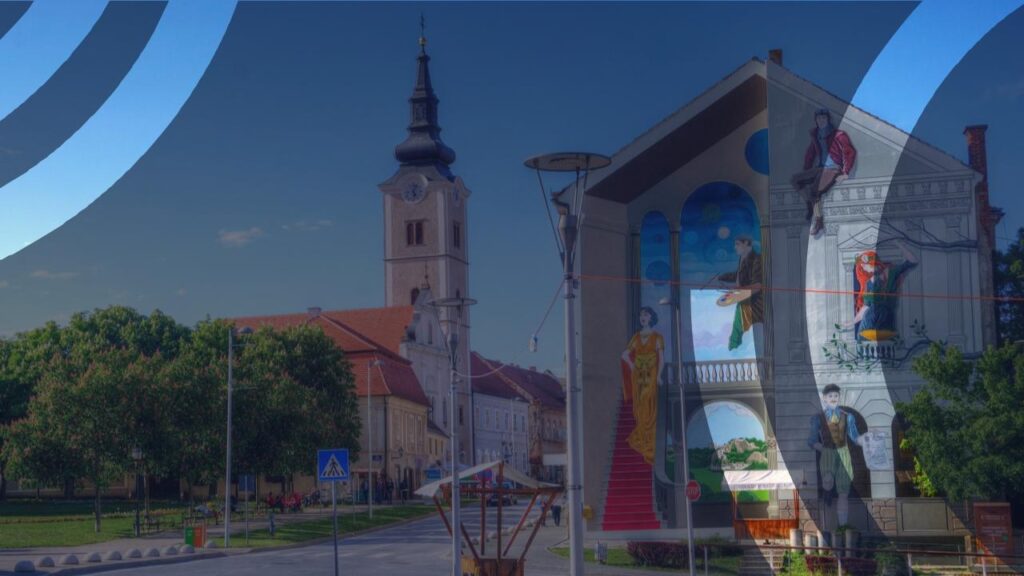
Due to this vision of the city, Križevci has been part of the European initiative “Future cities of South East Europe” since mid-2019, together with much larger cities, some of which are the capitals of their countries – Sarajevo. , Skopje, Maribor and Nis. What all cities have in common is a shared vision of the future, and that is the transformation of these cities into one of the best locations to live, work and visit in Europe by 2025.

All of them are part of a much larger process of urban transformation conducted by the European Institute of Innovation and Technology (EIT Climate-KIC) called Deep Demonstration, which is designed to address multiple societal challenges in the context of climate change in an integrated way and through a systems approach. The goal is to create a network of 100 climate-neutral cities by 2030.

Why cities? Because most of the population lives in cities. Economic activity, life, mobility, housing – everything takes place in cities that consume resources, create at the same time a large amount of carbon emissions and pollution, but also many opportunities for change for the better. Cities and citizens are key drivers of these changes for the better.

With this, Križevci, along with the cities of Amsterdam, Edinburgh, Copenhagen, Helsinki, Krakow, Madrid, Milan, Vienna, etc., has become one of the 15 most important cities-laboratories in Europe that will receive professional assistance and initial funding of up to about 7 million kuna in three years, for the transformation of the city into a sustainable and climate-neutral city, the city in which we want our children to live.

What does this mean for Križevci?

This is not a typical project, but a long-term process of  transformation of the city that we are starting together. The goal is to provide citizens with the foundations of a good life in the areas of housing, health care, education, mobility, energy, food, water, green public spaces, general security and good employment opportunities by 2025.

The project works together with the city on several levels:

  1. at the strategic level of planning,
  2. to involve and ensure citizen participation through digital and other tools and workshops,
  3. on projects that contribute to achieving the vision of the city – energy independent, resilient to crises and climate change, resources that are fairly shared and available to all citizens
  4. on the formation of an investment plan to provide funding for projects leading to the vision.

More specifically:

  • This process coincided with this year’s process of drafting a new City Development Strategy until 2030, which is an excellent opportunity to involve all stakeholders in development and change in the city – from entrepreneurs, youth, educational and cultural institutions to citizens’ associations, agricultural producers and the public and service sectors.
  • Precisely with the aim of involving a wider range of stakeholders in the development of the Strategy, during 2020 the project team in cooperation with partners from the city will conduct a series of consultation events in digital format, but also live when allowed due to the epidemiological situation caused by coronavirus.
  • The first such digital event was the challenge “Križevci today for tomorrow” conducted in the format of online hackathon from 7th to 8th of April, and already the next was held from 9th to 10th of May organized by the City Youth Council to collect and develop youth ideas as a contribution to the development of the vision and Strategy of the city.
  • Several more digital and physical public events and guided workshops are planned to get better acquainted with the vision of the city’s development and the development of ideas and steps leading to the realization of the vision. Thus, the process will be closer to the citizens and specific groups and enable their contribution to the Strategy and vision of the city, which will be incorporated into the content created through working groups.
  • By the end of June, the digital platform “Consul” for active involvement of citizens will be launched. The platform allows citizens to discuss topics that are important to them, to propose projects that they want to improve life in the city, but also to comment and vote on all presented ideas and projects and promote them through digital media; they will be able to vote on city proposals or participate in polls, and they will also be able to participate in public consultations on proposals for new regulations. All in one place, interactively and visually clear.

Another important moment from the European level, and that is the EU Green Plan and the EU’s commitment to a climate-neutral society and economy, coincided with the vision of the city, and that is Križevci, as an energy independent city. Križevci is moving towards the implementation of 100% renewable energy from the sun and geothermal sources by 2030 and the involvement of citizens in this transition. This is how the Križevci sunroofs, financed with the help of citizens, continue. Solarization of roofs, a larger photovoltaic power plant and the use of geothermal energy for the needs of the city are being prepared. KLIK – Križevci Climate Innovation Laboratory was established as the main assistant to the city and citizens in the development and implementation of these sustainable energy projects.

One of the ways to help realize the city’s vision, which the project implements, is the Eco District model – a model of urban development that develops neighborhoods in the city so that the equality of all who live and work in the community, resilience to shocks and stresses are at the heart of every decision. encountered and climate protection. This is how collaborative or collaborative, participatory management is formed.
To achieve the vision, it needs to be operationalized, so we are working on bringing together all existing and planned projects, ideas and activities to connect in a single capital investment plan for city development, ie. to form a portfolio of projects that will contribute to the vision of the city, but also climate neutrality.

Who are the partners:

  • The city of Križevci is a city with a vision and initiative
  • ZEZ is the project holder as an EIT Climate KIC partner
  • Through the project, a team “YES team” was formed, which manages the project, but also has extended members who are important for managing the development of the city, and these are entrepreneurs, associations, institutions, citizens and others.
  • For the purpose of the city’s energy transition, the local energy cooperative KLIK (or Križevci Climate Innovation Laboratory) was established, which this year has the support of the project, but aims to develop and become independent and become an important factor in the city’s energy transition.
  • Križevci will thus become a leader among small towns in Europe (with less than 50,000 inhabitants) and show how and in what way even small towns can fight climate change.

Future Cities of SEE

Last year, the City of Križevci, together with the Green Energy Cooperative, entered the European project “Future Cities of South East Europe” with 5 more cities, some of which are the capitals of their countries – Skopje, Sarajevo, Nis and Maribor.

The “Future Cities of SEE” project is part of a much larger process carried out by the European Institute of Innovation and Technology (EIT Climate-KIC) called Deep Demonstration, which is designed to address multiple societal challenges in an integrated and holistic way to create a network of 100 climate-neutral cities by 2030. With this, the city of Križevci has become one of the 15 most important cities in Europe (along with the cities of Amsterdam, Edinburgh, Copenhagen, Helsinki, Krakow, Madrid, Milan, Vienna, etc.) which will receive expert assistance to transform the city into a sustainable and climate neutral city. Thus, these cities will become one of the best cities in Europe for living, working and visiting by 2025. This will ensure that the cities involved in the project by 2025 provide citizens with the foundations of a good life in the areas of housing, health care, education, energy, mobility, food, water, green public spaces, general security and good employment opportunities.

Green Energy Cooperative has been cooperating with the city of Križevci for several years on various projects, the most famous one being the project “Križevci Sunroofs”, also an example of innovative business models of civic financing, which was recognized by the EIT. “.

The project will form a “Yes team” that includes a wide range of different stakeholders – from citizens, city administration, public and private companies and various non-profit organizations that will propose and implement various projects and programs to achieve the vision of a climate neutral city.

To achieve this vision, “Yes Team” has set several goals:

  • new “climate-neutral” innovative models will be developed through the project
  • social innovation will be encouraged by combining “bottom-up” and “top-down” approaches with active involvement of citizens in creating a sustainable and climate-neutral city (one of the activities that leads to this is participatory involvement of citizens in developing a new city strategy for 2021-2030 .)
  • building a community of young change-makers who will work to achieve the vision by surviving political instability and change
  • monitoring change and progress through the process
  • attracting investments with the aim of establishing self-sustainable and climate-resistant city districts and establishing Eco District certificates, implementation of Climathon for the purpose of co-creation of a new financial and organizational model of the city as a path to climate neutrality

The cities that are part of the “Future Cities” project will collaborate through the project, learn from each other, exchange ideas and work together to find solutions to their problems, which is one of the main features of this project.

Križevci will thus become a leader among small towns in Europe (with less than 50,000 inhabitants) and show how and in what way both small towns and citizens can fight climate change.

krizevci

Project “Acquisition of key skills in the field of environmental engineering”

At the beginning of the year, we became part of an important project for the future of environmental engineers. The project “Acquisition of key skills in the field of environmental engineering” aims to develop keywords of practical skills through the development, training and proven professional practice in the undergraduate and graduate study program Environmental Engineering (IO) at GFV. We want to facilitate the employment of students through the development of partner institutions with institutions that will apply the acquired theoretical knowledge in practice, establish Career Development Centers, strengthen social cohesion and increase the number of students in the STEM field.

The aim of the project is to improve and implement professional practice in the study of Environmental Engineering. One of the key aspects of the project will be the acquisition of knowledge and competencies about innovative solutions that balance the socio-economic needs and requirements of a healthy environment and nature. The result of the project is a developed institutional system of professional practice with the corresponding online system of planning and monitoring its quality. It is expected to strengthen cooperation with employers as well as increase the output competencies of students. This will have a positive impact on the implementation of environmental protection policies in the Republic of Croatia and the EU in the long run.

Total value of the project: HRK 3,974,834.79. The project is funded by the EU in one hundred percent.
Proven project period: 09.03.2020. – 09.03.2023.
Project holder: Faculty of Geotechnics, University of Zagreb, Varaždin (GFV)
Project partners: Green Energy Cooperative, Zagreb (ZEZ), Croatian Society of Geotechnical Engineers (HDIG), Polytechnic of Velika Gorica (VVG), Institute for Development and International Relations, Zagreb (IRMO), Association of Diplomats of the Faculty of Geotechnics, University of Zagreb (AMAC-GFV )

Contact person for additional information: Lucija Nađ
Email: contact@zez.coop

National Hackathon VersusVirus

After organizing the Challenge Today for Tomorrow in Križevci, we did not rest, but moved on. So, with the help of nine partners, we designed and implemented online Hackathon VersusVirus nationally. With the mobilization of cities and mentoring, our task was also communication. What does that mean? This means that everything you have read or heard about this hackathon has been curated by us.

Organizing a national Hackathon is not an easy thing that is done in two days, but it seemed like it. These are just some of the preparatory activities we did before launching the hackathon call:

  • The roles were divided among the organizers, and everyone gave their vision of the hackathon.
  • Voted for the hackathon name and then the visual identity of the hackathon was created.
  • Hackathon text was created for the website.
  • At the same time, the web site was developed, as well as the media announcement and FB event.
  • Public call for applications
  • The web was done Tuesday night and an invitation was immediately posted to the FB event with a link to the website.

Since it was already nine o’clock in the evening, we stayed with social networking and personal contact with all partners and friends that continued through Friday. We addressed the media on Wednesday morning when a press release was sent.

There were two major challenges in communicating the VersusVirus Hackathon: there was no communication plan and there was very little time for promotion. That’s why all the organizers got involved in spreading the information. The effort has paid off, more than 40 media outlets have published information on VersusVirus Hackathon, gradonačelnik.hr (media partner), Večernji List, ZIMO Dnevnik, Studentski.hr, BUG, Business, H-alter, Ekovjesnik and so on. An interview with Sandra Vlasic, member of ZEZ, also appeared on the tech portal Netokracija. Zoran Kordić, our manager, appeared on HRT’s program Good Morning Croatia. The news didn’t bypass the airwaves either, so you could hear the hackathon call on Radio Sljeme, Laganini FM and Radio HRT1.

The Hakathon officially kicked off on Friday night with an opening ceremony, but ideas were shared and teams formed earlier in the day in Slack. After 48 hours of team work, the jury selected the top five.
Three of the top five solutions for children and parents. Chatbot Dejana will help parents and teachers implement distance learning for children with disabilities. Naucime.online is a platform that helps connect students and mentors, to master school material, and the Stay (in) sane parenting hub helps all parents better organize their kids’ time, responsibilities and fun during self-isolation days. All parents among you will easily be able to use one of these solutions! Tilda is a digital donation platform through which help is collected for people in need such as those who were left homeless in the recent earthquake in Zagreb. In return for the donation, it offers customers a digital call with celebrities. The Green community rooftops for a better life wants to create rooftop gardens and balconies that contribute to our self-sustainability in terms of food, better air quality and urban quality of life.

These winning ideas are the result of a 48-hour anti-virus virus hackathon #versusvirusHR held this weekend that brought together 136 participants in a joint “hacking” of problems caused by the SARS-CoV-2 or COVID-19 pandemic.

VersusVirus is the first hackathon in the crisis time in Croatia held entirely in the virtual world, not counting the Challenge Today for tomorrow, which we successfully organized the week before in Križevci, which was a kind of hybrid between hackathon and challenge. As of Friday night, fifty hackers assembled across 15 teams worked on developing their ideas with the help of thirty mentors at their disposal. The task was to come up with innovative solutions to the problems caused by the coronavirus pandemic. Solutions were sought for a wide range of topics, from rapid crisis responses, the economy, education, the arts to community empowerment, the environment, governance, health, and solidarity. Participants and organizers were in constant contact through the Slack online application and the Zoom video conferencing platform, where they exchanged ideas, praise, criticism and even arranged exchange of fresh yeast.

In addition to the help of mentors, the teams also had the opportunity to follow virtual lectures to further learn or strengthen the knowledge and skills – how to maintain mental strength in times of crisis, what is impact and how to create projects with positive impact, o how to prepare a good story for a video, how to present an idea well, and some surprises in selling or coming up with mature ideas.

One of the participants, Martina Anisic, summarized her experience: “I participated in the hackathon for the first time because I liked the idea of working with talented people from different fields to find innovative solutions to the COVID-19 crisis in just one weekend. This has resulted in meeting people with different skills and experience, but with the same ambition – to make the most of our skills and come up with solutions that will specifically help our fellow citizens. I am thrilled with this event and the mentors who have been with us every step of the way – congratulations to this great event and I look forward to seeing what impact it will have on our community. ”

To combat the virus and deal with this and any other crisis, because they are all linked, we must be united, in solidarity, cooperate and act outside our established frameworks, and that is exactly what happened at the VersusVirus national hackathon on Sunday night.

The organizers of this event, who spent hours volunteering to pass the event without any difficulties, are: Impact Hub Zagreb, Technology Park Varaždin, Green Energy Cooperative, Terra Hub, North-West Croatia Regional Energy Agency, Lean Startup Croatia, Porin Development Agency, EIT RIS Climate KIC Hub Croatia, Ivy Digital and EduNorth.
We thank all participants and mentors and support organizations who will provide the further support needed to implement the ideas.

For more information on the winning ideas:
Web link at https://versusvirus.hr/ or https://versusvirus-croatia.devpost.com/.

Today for Tomorrow Challenge: Upgrade the system and restart Križevci Version 20.30.

by Sandra Vlašić, ZEZ, Terra Hub and EIT Climate-KIC Hub Croatia

“I want us to imagine how the city of Križevci can be a part of Europe and the world where we aim to keep the temperature rise up to 1.5 degrees C, as opposed to a pre-crises lifestyle scenario which leads us to a world 3-4 degrees warmer, a world where life for people will no longer be possible.” – that is how the Mayor of Križevci invited us to act. And so we did.

We did an experiment, a hybrid between a challenge and a hackathon. Twenty-four hours, four teams, 16 competitors willing to do something for their city and a dozen more supporting them as facilitators and mentors, tech-support wizards and mood-boosters. Most importantly, the teams were followed and supported by the local community actors – the Mayor, a Deputy Mayor, local foundation “I love Križevci”, local NGOs as well as by a newly founded initiative KLIK – Križevci Lab for Innovation for Climate.

Why an experiment, you ask, hackathons go around all the time?

True, but not in a crisis situation caused by a microscopic virus, not in a total COVID-19 global lockdown of everything. And not in Križevci! We did it for the first time exclusively in a #stayhome mode – online, using virtual meeting tools and shared documents on clouds for collaboration. No physical contact at all. Even the team who organised it, the Green Energy Cooperative or ZEZ, hasn’t met in person for almost a month. And we did it for the first time in Križevci, a lovely small city in central Croatia with a population of a bit more than 20.000. The experiment was done on freshly adjusted digital page ZEZ Impact which is an upgraded version of the one initially used for crowd-financing green energy projects. Now Impact is open for accepting broader ideas that aim to help in building flourishing communities. 

Days and nights, nights and days…

It took us eight days (and nights) to organise it and to mobilise the local community to apply. We challenged the citizens to imagine the future of their city after the crisis – a “Today for Tomorrow Challenge”. Due to the COVID-19 crisis we learnt that an overnight change is possible, because that’s what happened and we know that everything will be different when we wake up from this bad dream. Can we learn something from that and become better, can we restart the city into Križevci 20.30 version? On Wednesday April 8, the City Mayor invited the teams at the very beginning of the hackathon to imagine:

– how the economy and entrepreneurship will look like, any new jobs, how the way we do business can change?

– how we have helped in this crisis the most vulnerable social groups and how we can do it better, faster and more efficiently in the future?

– how we used digital solutions to connect us all to solve this crisis? How can we continue to work together in good times, not only in bad times?

Finally, the Mayor reminded that while using their imagination, they should bear in mind a universal challenge – that all these solutions are good for climate, carbon-free, green and sustainable. Because they want Križevci to be a city tailored both to people and nature! 

Vision, problem, solution-quest

The teams have done some joint visioning to help them with ideas and then picked one idea to focus on. They analysed the problems around the idea tandlooked into different aspects – social, technological, environmental i.e. climate and they looked into availability of resources necessary to solve it.

The teams put their ideas into a canvas and were up to look for different other elements necessary to have an initial plan – who are the beneficiaries? Who needs the solution they propose? Where is the market? Who are the partners they need and who are the competitors? What resources do they need, how much time, what would be the first steps towards implementation?

The time flew really fast – 24 hours for ideation, problem analysis and solution-finding, digging-out more information and structuring the pitch, dreaming big under the full Moon. Pitching session started on Thursday at 19h and a bit after 20h we’ve got the best team. In the jury we had representatives of Križevci local administration departments, local foundation and regional energy agency but also a representative of the City of Maribor from Slovenia who is also a part of the Future Cities of South-East Europe Team.

So what ideas emerged out of the challenge?

One is directly related to the COVID-19 crisis – a mobile solar-powered kiosk to be used for collecting samples for testing in times of epidemics. The kiosk would relieve the pressure from medical institutions and would allow easier access to citizens. For a small urban-rural setting like in Križevci, being mobile means being able to reach-out to distant villages as well and getting to where people in need are. 

The other three teams had very complementary ideas, but what was interesting is that they did not know about each other at all before the hackathon! Now they’ve discovered each other and realised they should collaborate and work together, which for sure will happen with the help of the project team working on Križevci as a Future City! This exactly was one of the aims of the hackathon – to activate local community and to get their visions for their city.

Those three “symbiotic” teams are: a Youth Hub to gather young people willing to go beyond regular education, to have a place to co-create together, learn and get some practice and get connected to the real sector and entrepreneurs, get some work experience. The goal is to increase the chances for employment and stay, live, work and thrive in Križevci.

The other two teams worked on connecting the currently broken local food chain. Križevci is traditionally known as a food-production region, but this was neglected due to high imports of food with low prices. The land and knowledge is abandoned. This crisis, when shops are limited and markets closed, showed us how important it is to have our own food production and to ensure self-sufficiency for food. Healthy food moreover. The idea is to create a platform beyond digital, that would connect and help both producers and buyers of local food, but would encourage more people to produce on their own. A platform would also offer learning and practice placements with farmers, sharing tools and mechanisation, sharing processing devices to produce higher value products and finally to share storage, delivery system and build a recognisable brand for locally produced food. Growing practice should aim for biodynamic and organic because that is better for our health and for nature, delivery and storage should be low-carbon with its own energy production. Learning modules can merge with the Youth Hub! The innovation is in closing the loop first, but no one said there wouldn’t be more innovative ideas when the teams will have more than 24 hours to look deeper into their models and test them.

We are all winners because it’s our future

The Youth Hub team officially won the first place according to the jury, but all of them were the winners! They recognised each other locally, they got connected, they had an opportunity to present themselves and their ideas to the city and other supporting organisations. Only now the journey for their ideas starts! 

What’s next, you ask? This experiment sets the ground for the national hackton we are co-organizing to engage more cities, communities and organisations in re-discovering ideas and regenerative solutions for strengthening local communities and building stronger local and regional ecosystems – now and after the crises!

What we have learnt is that it’s possible to organise and execute a hackathon in a rather short time in a #stayhome mode, with a low footprint, exclusively digital but with high social impact. Local community got connected and recognised! Their ideas came to light and will be supported to grow further. We should do it again and perhaps give it more than 24 hours.  If we narrow the focus of the challenge, we shall get even better ideas and solutions, get more people on board. What a rewarding experience for all!

The challenge-hackathon “Today for Tomorrow – Križevci Version 20.30.” was supported by the City of Križevci and Green Energy Cooperative, EIT Climate-KIC partner as a peace of puzzle of the big picture and as a part of a journey in the process of building a better city, the Future City of South-East Europe. This time, because of a COVID-19 lockdown, this journey had to be digital but showed that social connections can be built this way too. #stayhome and #imaginethefuture.

Join us! https://zezinvest.community/izazov-danas-za-sutra/

REGREEN-Fostering nature-based solutions for equitable, green and healthy urban transitions in Europe and China

The overall aim of REGREEN is to promote urban liveability, by systematically modelling and combining ecosystem services and biodiversity as the basis for nature-based solutions (NBS) that can be widely deployed by public and private actors. Such NBS, underpinned by evidence-based tools and improved urban governance, will enable urban planners and policy makers to meet contemporary and future challenges, such as climate change resilience, public health and well-being and social inclusion. Thereby REGREEN will accelerate the crucial transition toward equitable, green and healthy cities in both Europe and China.

REGREEN works through three Urban Living Labs (ULLs) in Europe and three in China: Europe: Aarhus (DK), Ile de France (F) and Velika Gorica (HR). China: Beijing, Shanghai and Ningbo.


REGREEN aims to substantially improve the evidence and tools supporting co-creation of NBS in urban settings, implemented in decision support systems for planning and governance, and developing business models for realising spatially relevant NBS, that provide multiple ecosystem services and wellbeing.

ULLs are a central element in the REGREEN concept, where co-creation of knowledge will involve local citizens, schools, businesses, organisations and public administrations enabling new forms of urban innovation.

REGREEN is funded under Horizon2020  SC5-13-2018-2019: Strengthening international cooperation on sustainable urbanisation: nature-based solutions for restoration and rehabilitation of urban ecosystems.

Grant Agreement No. 821016. AU coordinates REGREEN, which runs from Sept. 2019 – Aug. 2023. Total budget: 5mio €. 20 partners across Europe and China.

Contact persons: Coordinator Pia Frederiksen, pfr@envs.au.dk, Tel: +4587158539; co-coordinator Marianne Zandersen, mz@envs.au.dk, Tel: +4587158728

Good Energy and Economy/REScoops and Local Authorities: transforming communities through collaboration

Seven years of struggle for the promotion of community energy in Croatia – in the wake of REScoop.eu General Assembly in Zagreb

Pre-conference blog post for General Assembly of RESCoop.eu – EU Federation of energy cooperatives that will be held in Zagreb, from May 30 to June 1, and hosted by ZEZ

It has been now 7 years since we first time organized visit from REScoop association in Croatia to share us the experience from the energy coops movement across EU.

It’s been so inspirational that soon after that we cofounded ZEZ – Zelena energetska zadruga with the mission to promote this concept in Croatia.

5 years from now we became a full member of REScoop and started cooking some first projects – dealing with solar energy on schools and camps, recruiting first energy advisors team to fight energy poverty, making first consultation business.

We did advocacy too; together with national partners, we created a recommendation for policymakers how to create a favorable playground for energy cooperatives.

By that time, the whole renewable energy sector was blocked and there were only a few initiatives active, all initiated by the private sector.  But we keep on diving.

2 years from now we became Board member of REScoop.eu recognized as a link towards energy cooperative movements in Balkan region.

We had first projects in the region; laying some foundations for first community energy projects in Bosnia and Herzegovina and Serbia.

We focused on working with local authorities and created the first crowdinvesting campaign in solar energy for City of Krizevci that was awarded as one of the most innovative projects in EU.

Now, we are at home again, this time hosting not one member but whole REScoop federation in Zagreb for three days – with many more people and organization on board as partners and supporters.

This time to create some huge impact and aiming to:

  • Highlight collaborations between energy cooperatives and local authorities and laying the ground for some new projects
  • Mobilize more people and initiatives from Croatia and Balkan region to spread the movement
  • Encourage policymakers to create a more favorable ground for energy cooperatives and energy communities

Do not miss the chance to meet us!

International Conference – Good Energy and Economy

Leading European experts in renewable energy, solidarity economy, climate change, and energy cooperatives are coming in Zagreb

International Conference of Good Energy and Economy: transforming communities through collaboration between energy cooperatives and local authorities is organized from 30th May till 1st June in the City of Zagreb in collaboration with Green Energy Cooperative (ZEZ) and Green Network of Activist Groups (ZMAG) and their European partner’s network. Within the three-day conference, the 6th General Assembly of the European Federation of renewable energy cooperatives – REScoop.eu is organized.

At the conference 20 leading energy cooperatives from all over Europe will be present, as well as 10 representatives from the EU cities and the Western Balkan region, over hundred local and European experts, researchers, practitioners, decision-makers, social entrepreneurs, innovators, activist and enthusiast involved in civic energy, social and solidarity economy, food-based sovereignty, the development of energy-efficient communities, and energy-based models of different backgrounds, all of which share the same goal – to bring about positive social changes.

Numerous guests come from REScoop network – a European federation of renewable energy cooperatives that has over 1,500 members and from European network of solidarity economies – RIPESS that brings together over 40 organizations from across Europe who are involved in developing the economy for good purposes alike to employees, local communities, the environment, ecosystems and future generations.

The focus of this year’s conference is new economy models and practices from 10 EU member states that show ways of how energy cooperatives and other citizens initiatives cooperate with local authorities to realize RES projects and the benefits that it brings.

Participation for all three days is free of charge, registration is required and registration can be done via the link:  http://tiny.cc/pmz85y

With Dirk Vansintjan, a REScoops president and founder of the biggest energy cooperative in Belgium, Eco Power, representatives of the following networks, energy cooperatives and investment platforms are expected: Energy4All, Enercoop, Ecopower, Middelgrunden, Som Energie, De Windvogel.

PROGRAM

Some of the topics we highlight from the rich program are.

  • Energy Remunicipalisation – the restoration of public goods under the umbrella of local authorities
  • Creating a favorable legislative environment for energy cooperatives
  • Covenant of Mayors for Climate and Energy promotion
  • Creating energy independent communities and cities
  • Successful cooperation of local authorities with EU and Western Balkan energy cooperatives

The final program you can find here. The conclusions from the conference you can find here.

In the Tuškanac Cinema and the Croatian Chamber of Trades and Crafts we will learn about energy cooperatives and citizens engagement in the local policies, best practices of democratization in the field of energy from the European cities and the region, social and solidarity economics as a business foundation for responsible and sustainable society, common and public goods in the field of energy, housing, food and other important areas, workers’ cooperatives and the right to a dignified and fairly valued work, and to young farmers and farmers in Croatia as the highest value for the future.

REGISTRATION

Participation for all three days is free of charge, registration is required, and registration can be done via the link: http://tiny.cc/pmz85y. Registration for the conference is mandatory.

Solar Sonic Labs – Energy in the hands of youth!

By Deborah, Josip and Sanela

In the new crowdfunding campaign, we learned what it looks like when citizens take the energy in their hands and completely fund the solar power plant within less than 48 hours!

But, what happens when young people take energy in their hands? 

Hundreds of youngsters in the city of Križevci joined the global movement of high school strikes against climate change through the Solar Sonic Labs program and we decided to join them at the High School ”Ivan Seljanec”.

As we started (and ended!) the Campaign of Križevci Solar Roofs in the same week, we considered it necessary to further inspire and ‘ignite’ the situation in the city.

The Croatian edition of the protest was launched as a follow-up of the international School Strike 4 Climate, the famous global high school movement, initiated by 16-year-old Greta Thumberg from Sweden, founded to raise awareness of the consequences of climate change and global warming.

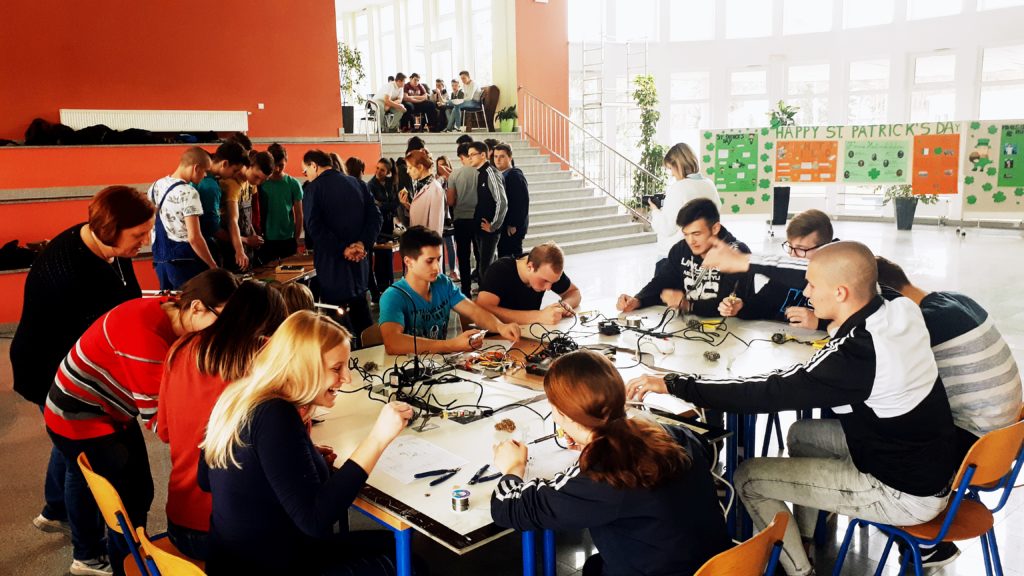
So, what did all of us do? The education program was divided into four modules. The workshops started shyly and with our attempts to literally draw volunteers from the ‘audience’ to demonstrate different technologies. “What’s with your computer?” workshop dealt with electronic waste and disposable technology, so the students could easily find out how to make a creative device from EE waste without fear of ‘blowing-up their garage’.

Through ‘Solar Micro Lab’ we presented the use of solar panels, LED – lighting objects and solar-powered electric motors. Students in the lab could, without any serious consequences, literary ‘burn’ the LED in order to see the results of a short circuit at the micro level. The aim of the workshop was to enable the transfer of knowledge of energy and light through entertainment, play and a few “burned-out” components.

As for the workshop ‘DIY Theremin’, it gave the opportunity to girls and boys to put their hands on soldering irons, transistors, capacitors and to learn the basics of electronics, at the same time creating a mini-version of theremin whose sound is modulated by light with a photo-resistor. At the end of the workshop, the participants could pack their mini-gadgets into plastic bottles and take them home to cheer up their families with truly a nice and sharp noises that are probably nailing down their ears. On this way, we wanted to emphasize the importance of recycling and re-use of consumables from our everyday lives.

The fourth module titled the Recycled Orchestra probably caused the greatest interest of high school pupils because it allowed them uninterrupted and loud ‘roar’ and ‘buzzing’ with the unusual DIY music instruments by Yuri Landman and Dirty Electronics in the school premises. The specificity of these electronic instruments is that they are made of wood, metal and plastic using discarded elements from the computer and the urban environment, such as a hard disk that is modulated into a bass machine or a plastic tube with a coil being playable on body movements. We only hope that with this workshop we initiated someone’s future music career.

After these wobbly beginnings, step by step, our students took all of these things in their hands and simply rocked down the workshops with numerous issues and music they created without fear of being interrupted due to the loud noise and echo in the school halls. We’ve plugged-out a few power fuses, but with so many soldering irons and gadgets plugged-in, we won the title of the greatest attraction of the week.

What did we learn and what did these workshops have shown us?

– There is a critical mass of young people who are willing to take responsibility.

– That in schools we need stronger power fuses and more solar energy!

– Something else.

Solar Sonic Labs has introduced to pupils many important topics on the protection of the environment, solar energy and the ability to use natural resources, to recycle materials and objects, how to creatively express yourself via technology and how through the curiosity and play they could eliminate fears from technology, thus creating a more innovative society where no one feels excluded.

The project was held in the partnership of the following organizations: Green Energy Cooperative – ZEZ, Terra Hub, Radiona / Zagreb Makerspace, Energy Office – City of Križevci and Faculty of Geotechnics.