SCCALE 20-30-50

Sustainable Collective Action of Citizens for Local Europe

By 2050, half of EU citizens could produce electricity on their own. Project SCCALE 203050 – Sustainable Collective Action of Citizens for Local Europe will provide an innovative view and a sustainable business model for energy efficiency to strengthen local communities. These activities will provide a clear and sustainable business model for energy efficiency in all its forms, with the support of citizens. The project will be implemented through two sets of parallel activities that will build upon each other. One set of activities will focus on the implementation of pilot projects for the development and dissemination of the concept of energy communities. The second set of activities will include the development of the SCCALE Toolkit, package of 7 tools developed and tested through pilot projects, which will validate lessons learned and support replication and consolidation of established energy communities.

Key project activities include:

  • Development of a step-by-step guide for energy communities
  • Development of tools for monitoring the development of energy communities
  • Systematization of proven technical tools and financing models suitable for collective action of citizens
  • Development of financially stable models for innovative energy efficiency and building renovation projects
  • Encouraging the expansion of energy communities across Europe (including municipalities, SMEs, NGOs, and academic institutions)
  • Supporting policymakers at European, national and local levels to support energy communities

The main goal of the project is to establish energy communities, with the ambition to:

  • Establish at least 26 energy communities during the project and support the establishment of at least 34 additional communities
  • Encourage the establishment and development of at least 96 energy communities in the next 5 years
  • Develop a comprehensive methodology for establishing replicable energy communities across Europe and beyond

The implementation of the project begins on June 1, 2021 and will last for 42 months. The project is funded by the Horizon 2020 Research and Innovation Program under the Grant Agreement no. 101033676.

PARTNERS:

REScoop.eu, Ecopower, Enercoop, EnergieSamen, Electra, Energy Cities, Green Energy Cooperative, Delft University of Technology, Municipality of Leuven, Municipality of Poreč

I-NERGY

Artificial Intelligence for Next Generation Energy

The overall vision and main objective of the project is to deliver an innovative energy-specific open modular framework for artificial intelligence (AI), which relies on a highly distributed open-source interoperability reference architecture. I-NERGY will enable cross-sectoral AI-based analytics for integrated and optimized smart energy management, based on seamless exchange of data, information, and knowledge under relevant principles of sovereignty and regulation.

The project aims to develop, upgrade and demonstrate an innovative AI tool adapted to energy (I-NERGY Toolbox), based on the I-NERGY platform, which will significantly contribute to achieving techno-economically optimal management of the electricity and energy systems (EPES) value chain. This will range from optimal risk assessment for planning energy efficiency investments to optimized grid and non-network owned assets, improving the efficiency and reliability of electricity grids.

The virtual energy community in Croatia will bring together 100 consumers with installed solar power plants (focusing on private households, but also exploring opportunities for the introduction of non-residential buildings – public buildings, industrial parks, etc. to diversify consumer types). Beneficiaries involved in the project will be deployed in at least 5 geographical areas (focusing on cities in Croatia that already work closely with the Green Energy Cooperative).

Objectives to be achieved include:

organization of approximately 100 prosumers (namely households) equipped with solar power plants in the virtual energy community;
utilization of AI toolbox developed within the project for the goal to allow peer-to-peer energy trading within the community;
utilization of AI toolbox developed within the project for the goal to allow the appearance of the virtual energy community on the auxiliary services market;
developing policy recommendations based on the project experience.

Users and owners of small solar power plants who have installed their solar power plant through Green Energy Cooperative’s Nasuncanojstrani.hr service, we offer to become part of the first virtual energy community and get acquainted with tools for P2P sharing and electricity trading. Through their participation, they will help to adapt the concept of distributed electricity generation and the direction in which the global electricity market is adjusting to the local context, as well as help to improve the regulatory framework.

The project started on January 1, 2021, and will last 36 months. The project received funding from the Program for research and innovation Horizon 2020 within the grant agreement no. 101016508.

Partners:

INSTITUTE OF COMMUNICATION AND COMPUTER SYSTEMS (ICCS), ENGINEERING – INGEGNERIA INFORMATICA SPA (ENG), RHEINISCH-WESTFAELISCHE TECHNISCHE HOCHSCHULE AACHEN (RWTH), COMSENSUS, KOMUNIKACIJE IN SENZORIKA, DOO (COMSENSUS), FUNDACION CARTIF (CARTIF), DEUTSCHES FORSCHUNGSZENTRUM FUR KUNSTLICHE INTELLIGENZ GMBH  (DFKI), Parity Platform, FUNDINGBOX ACCELERATOR SP ZOO, CENTRO DE INVESTIGACAO EM ENERGIA REN – STATE, GRID SA, ASM TERNI SPA  (ASM Terni), SONCE ENERGIJA D. O. O.  (SONCE/Suncontract), IRON THERMOILEKTRIKI ANONYMI ETAIREIA  (HERON/PARITY), ZELENA ENERGETSKA ZADRUGA (ZEZ), STUDIO TECNICO BFP SOCIETA A RESPONSABILITA LIMITATA (BFP), VEOLIA SERVICIOS LECAM SOCIEDAD ANONIMA UNIPERSONAL, RIGA MUNICIPAL AGENCY “RIGA ENERGY AGENCY”  (LEIF), FUNDACION ASTURIANA DE LA ENERGIA

ReDREAM

ReDREAM
Engagement of electricity consumers through the development of a new user-oriented ecosystem in a multi-market scenario

ReDREAM, the latest European initiative from the European Union’s Horizon 2020 Research and Innovation Programme, will revolutionize the way we use renewable energy and radically rethink the power system to put consumers at the center of the energy transition.

The goal of the REDREAM project is to enable greater consumer engagement (within the residential, industrial, and tertiary sectors) in the energy market, through an open platform that allows direct communication between different actors. Addressing this challenge requires the use of advanced IT tools and services, to successfully respond to demand and improve the predictability of consumption patterns and consumer behavior.

The emphasis is on energy efficiency, locally produced energy and flexibility of people. The new ecosystem will be designed for optimal management of energy resources and more active involvement of people in the energy transition. If people use lighting, ventilation, heating, cooling, and electromobility flexibly, then greater energy efficiency will occur. Consumer benefits include lower bills, better comfort, and modern aesthetic technology in the home.

The key factors will be the involvement of different groups of consumers and producers at 4 DEMO sites in Europe (Spain, Italy, England, and Croatia), as well as the support and engagement of the local community and local government representatives. In Croatia, the DEMO location will be the City of Varaždin.

Changes in consumer behavior will be monitored and encouraged through the use of smart devices, i.e. smart meter devices for household appliances, and controllers for heat or cooling in industrial plants. These devices will be provided by the Green Energy Cooperative for citizens-owners of small solar power plants and organizations that will participate in research as part of the project.

Key project activities:

Networking and user interaction through an open platform
Strengthening the local community through the involvement of people in the energy transition
Reducing energy bills by installing smart devices
Increasing energy efficiency and environmental protection
Citizens get a major role in the energy transition by changing user behavior

The project started on October 1, 2020 and will last for the next three years. The project has received funding from the European Union’s Horizon 2020 Research and Innovation Programme under the Grant Agreement no. 957837.

Partners:
Universidad Pontificia Comillas (project coordinator)

Other partners:
Green Energy Cooperatives (ZEZ), Stemy Energy, Time Lex, Energetica S Coop (ECOOP), Soulsight Design Strategy, Civiesco Srl,  Associazione Bio-Distretto Della Via Amerina e Delle Forre (BIO), Rimond Srl, Bath & West Community Energy Limited (BWCE), National Technical University of Athens (NTUA), Communaute D’universites et Etablissements Universite Bourgogne – Franche – Comte (UBFC), Omi – Polo Espanol Sa (OMIE), European Science Communication Institute (ESCI) and Olivoenergy Consulting Sl (olivoENERGY).

NUDGE

NUDGE - Nudging consumers towards energy efficiency through behavioural science

Renewable energy sources, such as solar, still cannot be stored in large quantities, reducing the efficiency of their use. We want to encourage the adoption of habits by consumers that will change that, and enable them achieve savings, too.

Achieving the full potential for the energy transition requires a paradigm shift, finding alternative solutions that involve as many people as possible while having access to support in reducing energy consumption.

Reducing energy consumption requires behavioral changes, from behaviors when using heaters and electrical appliances, to behaviors that contribute to the energy inefficiency of our homes.

In order to encourage change, a digital approach (eg. smart meters) will be applied, which enables energy consumers to actively and efficiently monitor and manage energy consumption, as well as education for the best possible application and adoption of new habits.

10 partners from 7 European countries gathered to test innovative energy efficiency models in the use of renewable energy sources.
Their goal? Study, test, and evaluate various behavioral interventions for energy efficiency at 5 demo sites in Greece, Belgium, Germany, Portugal, and Croatia (Varaždin), paving the way for new policies and human behavior.
Systematically assess and fully unleash the potential of behavior towards achieving greater energy efficiency by adopting new behaviors, which will support public policies to increase energy efficiency.

The project started on September 1, 2020. and will last for the next three years. The project has received funding from the European’s Union Horizon 2020 Research and Innovation Programme under the grant agreement no. 957012.

Project partners:
Institute for European Energy and Climate Policy Stichting – IEECP (main coordinator)

Other partners:
Idiotiki Kefalaiouchiki Etaireia (DOMX), Athens University of Economics and Businees – Research Center (AUEB-RC), Instituto de Ciencia e Inovacao em Engenharia Mecanica e Engenharia Industrial (INEGI),  Fraunhofer Gesellschaft zur Foerderung der Angewandten Forschung E.V. (Fraunhofer), Green Energy Cooperative (ZEZ), MVV Energie Ag (MVV), Interuniversitair Micro-Electronica Centrum (IMEC), Spring-Stof i Associazione Cittadinanzattiva Onlus (ACN).

Energetski neovisna škola OŠ Ostrog

O projektu

Energetski neovisna škola Ostrog

Energetska zadruga Kaštela ostvarila je ideju prve energetski neovisne škole (koja je ujedno i njihov član), u suradnji s UNDP Hrvatska, Zelenom energetskom zadrugom, Splitsko-dalmatinskom županijom i lokalnim privatnim tvrtkama. Uz prethodnu zamjenu klasičnih žarulja novim i pet puta efikasnijim LED žaruljama, solarnom elektranom (22 kW) na svom krovu škola proizvodi električnu energiju za vlastite potrebe. U osnovnoj školi Ostrog u Kaštel Lukšiću ostvarena je tako potpuna energetska neovisnost u smislu električne energije.

Ovo je jedan od prvih primjera organiziranja lokalne zajednice u energetsku zadrugu i realizaciju konkretnog projekta u Hrvatskoj. Isto tako, instalacija solarne elektrane je napravljena bez državnih poticaja, po modelu koji je primjenjiv i za druge škole i energetske zadruge.

Rezultati

Prvi put u Hrvatskoj implementirali smo inovativne modele financiranja kao što je crowdfunding za solarnu elektranu, kroz što su osigurana početna sredstva za energetski neovisnu osnovnu školu, neto mjerenje i ESCo ugovor te suradnja između energetskih zadruga i predstavnika lokalnih vlasti. Putem crowdfunding kampanje, kroz Indiegogo platformu i lokalnu akciju, za školu je sakupljeno oko 130 tisuća kuna.

Trajanje projekta: 2013-2014

The First Solar Roof in Croatia in Hands of the Citizens

Story by Sandra Vlašić, June 13th 2018

Exactly sixty years ago, back in 1958 all eyes were up on the Cat on a Hot Tin Roof and Elizabeth Taylor in a splendid drama peace by Tennessee Williams. Back then, our story was a fiction. Now, all eyes are up on Križevci Solar Roofs and we have a true story that is a hit!

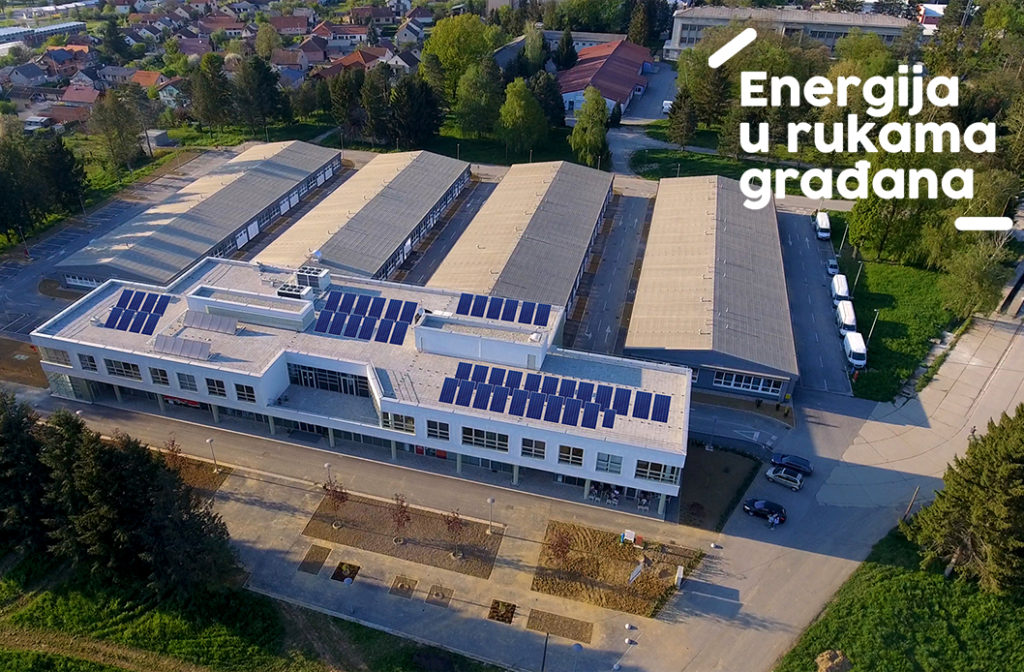
Our story is about a solar power plant of 30 kW on the roof of Development Centre and Technology Park in Križevci, lovely small city 60 kilometres away from Zagreb, Croatian capital. The city is small, but it is the first city in Croatia that has a solar power plant entirely financed by the citizens as small investors. How?

ZEZ started it but is not alone

The initiative came from the Green Energy Cooperative or ZEZ who developed the project together with partners from the city of Križevci, Regional Energy Agency North, Greenpeace Croatia, Solvis and ACT Group. ZEZ was working on technical and economic elements of the project for almost a year, then we prepared and launched a crowd-lending campaign to raise necessary amount of 230.000 kuna (30.000 euro) to build the solar plant. And – boom: in just ten days, it was fully funded!

This was the first crowd-lending project in Croatia for the first citizen energy project. The amount was collected in ten days by 53 small investors, based on micro-loans model. ZEZ will return the loans to investors with 4.5% of interest over a period of 10 years, from the income generated by electricity production of the solar power plant on the roof. The minimum investment chip was 1000 kuna (130 euro), the maximum was 10.000 kuna (1300 euro) and the average in this project was 4000 kuna (500 euro).

The interest is high, energy transition is on the way

The interest expressed during the campaign goes up to almost double the amount that was needed, while today, a month after the campaign, it is up to 1 million kuna and more then hundred people willing to invest into renewable energy sources. This shows that people are willing and interested to invest into good projects with high impact. In this case, there is positive impact on climate change and environment, on local community and economy – all the equipment comes from a Croatian company and the jobs are local. Green electricity will power the needs of Development and Technology Centre tenants and demonstrates a great positive example for the others. There is already interest within Križevci to power more roofs and there is interest from other cities like Pazin, Pleternica or Velika Gorica for similar renewable installations that would be powered by citizens.

This is the beginning of a true energy transition in Croatia, just like the vision ZEZ had back in 2013 when it was established as one of the first energy cooperatives in Croatia. Today, ZEZ is a leading energy cooperative in Croatia and the region, is a member of management board of the European Federation for renewable energy cooperatives (REScoop.eu) and the right hand of the Energy Cities (the European Association of local authorities) in Croatia.

What we were waiting for?

The solar power plant in Križevci is the first project based on the microloans model and anyone, you and I, could be a part of it thus taking energy in our hands. So far, we haven`t had this opportunity in Croatia while the Sun is on our side of the street – studies show that by the middle of this century half of citizens of Croatia could produce their own (our own!) energy. In Europe and the world this is a usual way of developing the energy market and the local community. The technical solution is available, business models are known, what we were waiting for?

In Germany 50% of renewable energy installations are owned by the citizens in Denmark it is more, three quarters of wind energy is in the citizens’ hands. Some of them are gathered in an energy cooperative, some are not, it is not necessary, but it is useful because the cooperative has greater strength in every way. Now we have the first renewable energy installation in Croatia owned by the citizens, with a little help of ZEZ. This is only the beginning because when ZEZ says “energy in the hands of citizens”, we mean it.  With this project in Križevci we have shown you how.

“The dark days are gone, and the bright days are here, My Sunny one shines so sincere…”